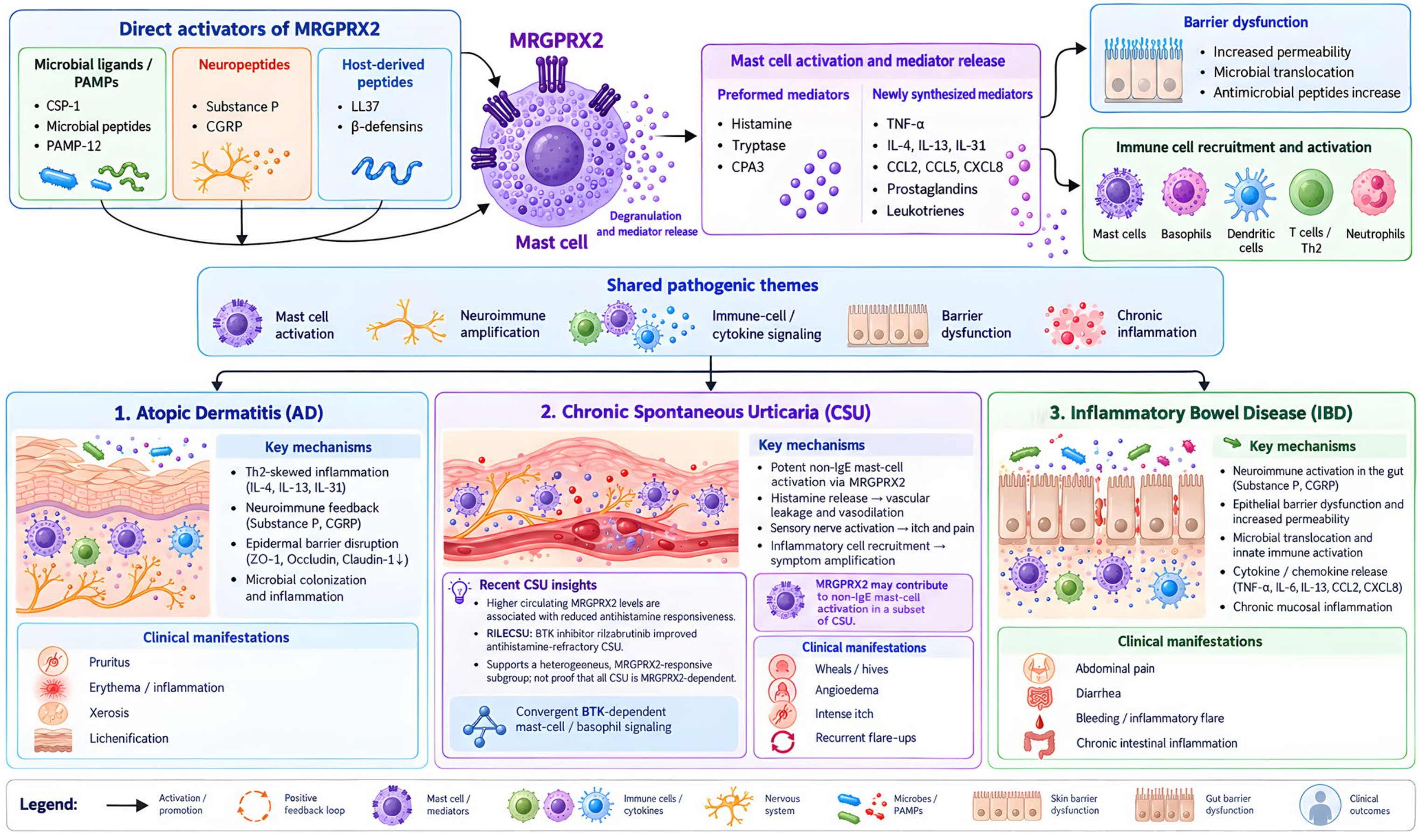
An international research team involving AlphaMol Science Ltd and the Medical University of Vienna, has published a comprehensive review in Clinical Reviews in Allergy & Immunology, entitled “MRGPRX2 in Allergic and Immune-Mediated Diseases: Mechanisms, Clinical Relevance, and Therapeutic Translation.”
The publication examines the molecular mechanisms, disease relevance, and therapeutic development of MRGPRX2, an emerging G protein-coupled receptor (GPCR) target in allergic and immune-mediated diseases.
Distinct Mechanisms in Acute Allergy and Chronic Inflammation
MRGPRX2 is predominantly expressed in tissue-resident mast cells and mediates IgE-independent immune activation.
Its canonical G protein signaling, involving Gαq/11 and Gαi pathways, triggers intracellular calcium mobilization and rapid mast cell degranulation, releasing histamine, tryptase, and other inflammatory mediators. This pathway is closely associated with acute allergic-like responses and non-IgE-mediated drug hypersensitivity.
In contrast, MRGPRX2-associated chronic inflammation may involve more complex mechanisms, including sustained inflammatory signaling, neuroimmune amplification, and intercellular communication.
Emerging studies have demonstrated that MRGPRX2 stimulation can enhance mast cell extracellular vesicle release, raising the possibility that extracellular vesicles, including exosomes, contribute to the propagation of chronic inflammatory signals. However, the extent to which this mechanism drives chronic disease remains to be established.
Therapeutic Potential Across Multiple Diseases
The review systematically evaluates MRGPRX2 involvement in chronic spontaneous urticaria (CSU), atopic dermatitis (AD), and inflammatory bowel disease (IBD).
Human studies suggest that MRGPRX2 may contribute to mast cell hyperreactivity in selected CSU patients, neuroimmune and type 2 inflammatory amplification in AD, and mucosal inflammatory signaling in ulcerative colitis.
These findings support continued investigation of MRGPRX2 as a potential precision therapeutic target.
Advancing MRGPRX2-Targeted Drug Development
The authors also assess different pharmacological approaches, including orthosteric antagonists, negative allosteric modulators, and inverse agonists.
Among the programs discussed is AlphaMol's oral MRGPRX2 modulator AM-001 (Alpha-0261), a partial inverse agonist currently undergoing Phase 1b clinical investigation in CSU.
Understanding the distinct mechanisms underlying acute mast cell activation and chronic inflammatory amplification, together with improved patient stratification and target-engagement biomarkers, may help guide the next generation of MRGPRX2-targeted therapies.
Publication Details
Journal: Clinical Reviews in Allergy & Immunology
DOI: https://doi.org/10.1007/s12016-026-09215-w